A Practical Guide to Exploring China Through the Yangtze River Delta
For many international companies, a first visit to China begins and ends in Shanghai.
Shanghai is an obvious starting point. It is an international financial center, a major trading hub and one of China’s most globally connected cities.
But if the purpose of a China trip is to understand how business actually works in China, staying in Shanghai may only provide part of the picture.
Some of China’s most important manufacturing capabilities, technology companies, industrial clusters and innovation ecosystems are located outside the city.
This is particularly true across the Yangtze River Delta.
For international companies considering China, the question should therefore not simply be:
“Should we visit Shanghai?”
A better question is:
“What other cities should we connect with to understand the China business ecosystem relevant to us?”
Here are five cities worth putting on the radar.
- Shanghai: The International Gateway
Shanghai is often the natural starting point for international visitors.
The city combines finance, international trade, professional services, technology, consumer markets and multinational corporate networks.
For overseas companies, Shanghai can be particularly useful for:
- Understanding China’s broader business environment
- Meeting multinational companies and professional service providers
- Exploring consumer and financial markets
- Connecting with investors and business organizations
- Establishing an international base for a China program
But Shanghai’s greatest value may be its role as a gateway.
The city can provide the international context.
The surrounding Yangtze River Delta can provide the industrial context.
That combination is often much more informative than treating Shanghai as an isolated destination.
- Suzhou: Where Manufacturing Meets Innovation
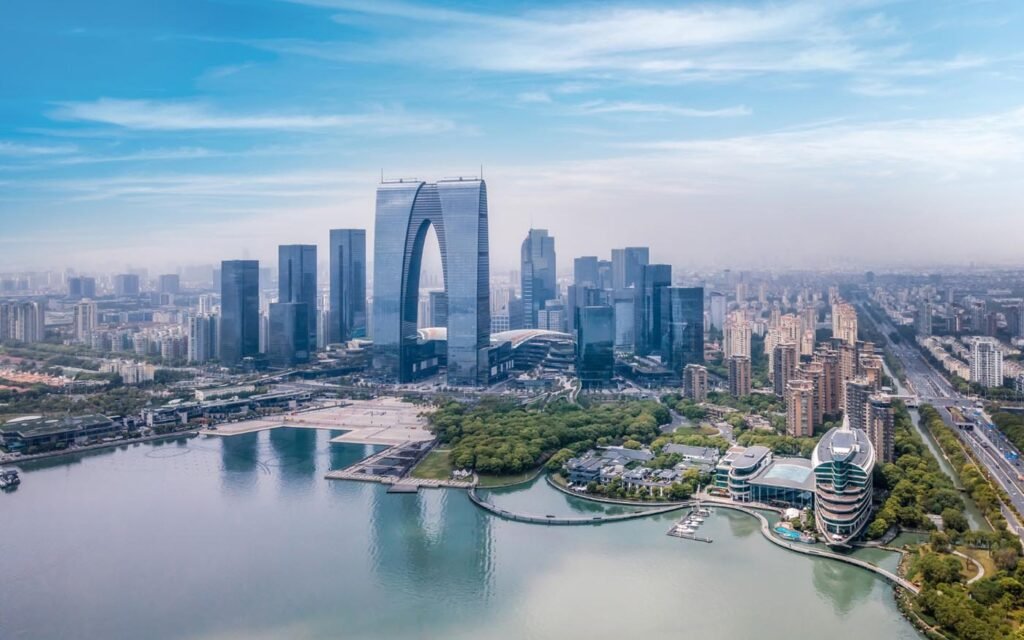
Located west of Shanghai, Suzhou is one of the most important industrial and manufacturing centers in the Yangtze River Delta.
The city has developed a sophisticated industrial ecosystem covering areas such as advanced manufacturing, electronics, equipment, biomedicine and high-tech industries.
For international companies, Suzhou offers a different perspective from Shanghai.
Instead of primarily observing China’s international business environment, visitors can explore how companies operate inside a highly developed industrial ecosystem.
A visit could focus on questions such as:
- How are international and Chinese companies working together?
- How do manufacturers upgrade through automation and digitalization?
- What does an advanced Chinese supply chain look like?
- How do industrial clusters support innovation?
- What opportunities exist for technology cooperation?
For companies interested in manufacturing, industrial technology or supply chains, Suzhou can be a particularly valuable stop.
- Wuxi: A Window into Industrial Technology
Wuxi is smaller and less internationally visible than Shanghai.
That is precisely why it can be interesting.
The city has a strong industrial foundation and has developed capabilities across areas including integrated circuits, IoT, intelligent manufacturing, new materials and other technology-oriented industries.
For an international visitor, Wuxi can offer something that a major international city sometimes cannot:
A closer look at how technology is integrated into real industrial environments.
The important question is not simply whether a company has advanced technology.
It is how that technology is being applied.
For example:
- How is AI being integrated into manufacturing?
- How are factories becoming more intelligent?
- How are traditional manufacturers adopting digital technologies?
- How do technology companies work with industrial customers?
- What does China’s industrial digitalization look like on the ground?
These questions can turn a company visit from a simple factory tour into a genuine learning experience.
- Nanjing: Technology, Research and Industrial Depth
Nanjing is another important city within the Yangtze River Delta.
As a major educational, scientific and industrial center, the city offers a different combination of resources.
Its universities, research institutions, technology companies and industrial enterprises create opportunities to explore the relationship between research, innovation and commercialization.
For international organizations, Nanjing can be particularly relevant for programs involving:
- Universities and research institutions
- Technology innovation
- Engineering
- Advanced manufacturing
- Industrial cooperation
- Talent and education
- Research commercialization
This makes Nanjing potentially valuable for companies and professional groups that want to understand not only China’s factories and markets, but also the knowledge and innovation infrastructure behind them.
- Hangzhou: Digital Business and Entrepreneurship
Travel southeast from Shanghai and the business environment begins to change again.
Hangzhou is widely recognized for its digital economy, technology companies, entrepreneurship and e-commerce ecosystem.
The city provides an interesting contrast to the manufacturing-oriented cities of Jiangsu.
For international companies, Hangzhou can be useful for exploring:
- Digital commerce
- Consumer technology
- Software and technology services
- Entrepreneurship
- Digital transformation
- New business models
- China’s rapidly evolving consumer economy
This creates an important lesson.
China’s competitiveness cannot be understood through manufacturing alone.
The country’s industrial capabilities increasingly interact with software, digital platforms, data, logistics, finance and consumer technology.
Hangzhou provides a valuable perspective on that side of the equation.
Five Cities, Five Perspectives
These cities should not be viewed as a simple checklist.
Each can provide a different lens through which to understand China.
City Potential Perspective
Shanghai International business and global connectivity
Suzhou Advanced manufacturing and industrial ecosystems
Wuxi Industrial technology and digital transformation
Nanjing Research, education and innovation
Hangzhou Digital economy and entrepreneurship
The real value comes from connecting these perspectives.
For example, an international technology company might begin in Shanghai to understand the broader business environment, continue to Suzhou to explore manufacturing, visit Wuxi to examine industrial applications, and then travel to Hangzhou to understand digital business models.
That is more than a business trip.
It is a structured way of understanding different layers of the Chinese economy.
The Wrong Way to Plan a China Business Trip
One common mistake is to start with a list of famous companies.
The itinerary might look like this:
Company A → Company B → Factory C → Dinner → Airport
There is nothing inherently wrong with visiting companies.
The problem is the lack of a clear learning objective.
A company visit becomes much more valuable when the visitor knows why the company is being visited and what should be learned from it.
Before arranging meetings, international organizations should ask:
What are we trying to understand?
Is the objective market research?
Technology discovery?
Supplier identification?
Potential partnerships?
Industry benchmarking?
Investment exploration?
Or simply developing a deeper understanding of China?
The answer should determine the itinerary.
Geography Should Follow the Business Objective
There is no universal “best China itinerary.”
A consumer technology company may benefit from spending more time in Shanghai and Hangzhou.
An industrial automation company may gain more value from Shanghai, Suzhou and Wuxi.
A university or research organization may want to include Nanjing.
An organization interested in China’s manufacturing ecosystem may need a completely different route.
This is why geography should follow the business objective—not the other way around.
The purpose of a China experience is not to collect city names.
It is to build a coherent understanding of a market, industry or ecosystem.
From Company Visits to Ecosystem Exploration
At Ming Yue International, we believe this distinction is important.
Our role is not simply to arrange visits.
We design customized China experience programs around the objectives of international companies, organizations and professional groups.
Depending on the project, a program may combine:
Industry Visits
Meet relevant manufacturers, technology companies and industry organizations.
Business Exchange
Create opportunities for meaningful conversations with potential partners and local business leaders.
Innovation Exploration
Examine how Chinese companies develop, commercialize and apply new technologies.
Market Discovery
Experience China’s business environment through direct observation and local context.
Cultural Experience
Understand the local environment that shapes business relationships and communication.
Local Coordination
Manage the practical details required to make a multi-city China program efficient and coherent.
The objective is simple:
Turn a trip to China into a structured learning and business experience.
China Is Bigger Than One City
Shanghai may be the right place to start.
But it does not have to be the place where your China exploration ends.
The Yangtze River Delta demonstrates why.
Within a relatively connected region, international visitors can encounter financial services, advanced manufacturing, industrial technology, research institutions, digital businesses and entrepreneurial ecosystems.
That diversity is precisely what makes the region valuable for international business exploration.
The challenge is knowing where to go, whom to meet and what questions to ask.
That is where local knowledge becomes important.
Start with a Question, Not an Itinerary
If your organization is planning a China visit, start with three questions:
- What do we want to understand?
- Who do we need to meet to understand it?
- Which cities provide the strongest context?
Only after answering these questions should the itinerary be built.
Because the best China business trip is not necessarily the one with the most meetings.
It is the one that produces the most useful insights, relationships and next steps.
Explore China Beyond the Map
Ming Yue International helps international companies, organizations and professional groups design customized China experience programs across the Yangtze River Delta and other selected regions of China.
From company visits and industry learning to innovation exploration, business exchange and cultural experiences, we build programs around your objectives—not a standard itinerary.
Experience China with purpose. Connect with confidence.