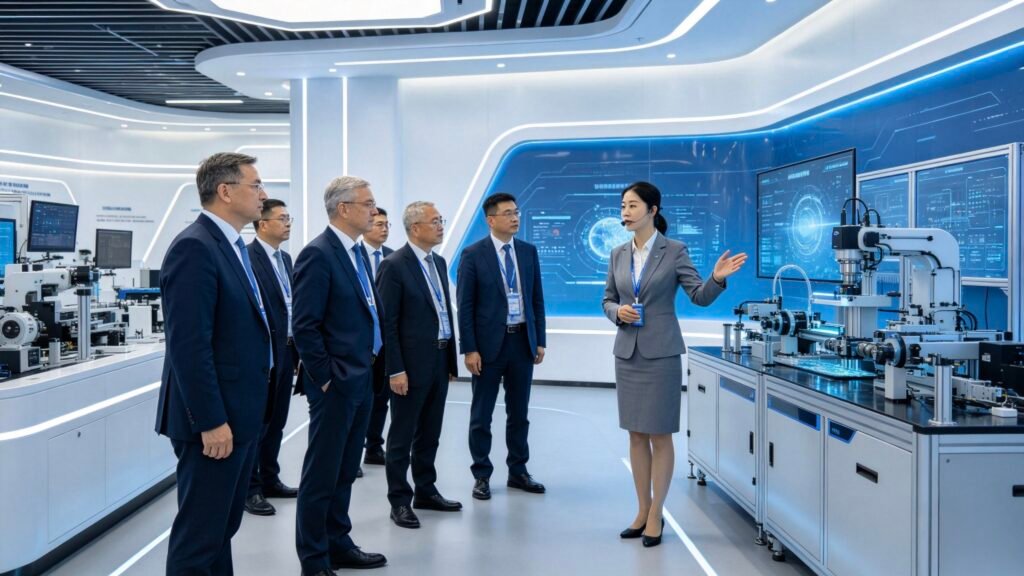
Do you need a “ticket” to tour Chinese factories? Recently, Reuters reported the phenomenon of “global tech professionals flocking to China for site visits”: study tours with a maximum fee of 15,000 US‑dollars for a five‑day itinerary are drawing strong sign‑ups; free tour slots at Xiaomi Auto’s factory require public lotteries, and “tickets” for factory visits have been resold for as high as 300 US‑dollars each on second‑hand platforms. This is not a rush to buy Labubu blind‑box toys, but the registration page for Chinese factory tours. Senior executives from investment institutions and tech industry figures travel all the way to China, solely to closely observe production lines at China’s smart factories.
The high price of these “tickets” stems from the value‑added prowess of China’s smart manufacturing. Markets never pay a premium for ordinary goods. The willingness of foreign entrepreneurs to pay hefty sums for cross‑border study tours speaks volumes about the irreplaceable observational value of the production models demonstrated by Chinese factories. At Xiaomi Auto’s Beijing plant, one complete vehicle rolls off the assembly line every 76 seconds on average. Since opening its doors, it has received more than 250,000 visitors from over 70 countries and regions, with instances where tens of thousands of applicants competed for merely 20 slots. At Geely’s Xi’an base, core processes including stamping, welding and painting boast a 100‑percent automation rate, with one new vehicle coming off the line every minute on average. Humanoid robot demonstrations in Hangzhou have become a standard item on the itineraries of many foreign dignitaries visiting China. Data from the International Federation of Robotics offers further compelling evidence: in 2024, 295,000 new industrial robots were installed in China, exceeding the combined total for the rest of the world. By comparison, Germany recorded roughly 27,000 units and the United States around 34,000 units. Facts show that China stands as a key arena for the new round of technological transformation. The difficulty of securing a visit slot serves as a vivid testament to the global spotlight on China’s technological advancement.
The essence of this “study‑tour boom” lies in opportunities for cooperation, not narratives of threat. Some attribute the difficulty of obtaining tour slots to anxiety over the so‑called “China Shock 2.0”, which likely misinterprets the true intentions of these visitors. Immersive exposure to China’s technology has become a vital channel for foreign investors to understand China and identify future opportunities. Organizers note that even without investing in China, enterprises worldwide will inevitably compete with Chinese firms in global markets, making on‑site visits a necessary due‑diligence practice.
Organizers of one China‑bound study tour stated that about half of its participants hail from Southeast Asia. Since late 2025, multiple delegations of European enterprises have also travelled to China to learn and draw inspiration. Shenzhen also presents striking figures: inbound foreign tourist arrivals rose by 70 percent last year, and as of August 4 this year, cross‑border entries and exits by foreign nationals via Shenzhen ports have surpassed 5 million. A cohort of entrepreneurs shuttling between Silicon Valley and Shenzhen complete prototype development and align supply‑chain resources locally. One US manufacturing consultant put it plainly: front‑line practitioners pay little heed to political rhetoric, and American robotics companies still source large volumes of components from China. While tariff barriers and export controls keep tightening, capital and enterprises across the globe are voting with their actions. This contrast between two sets of facts speaks for itself.
It is not only tech and industrial‑sector players who have become captivated by Chinese factory tours. As an alternative form of “China Travel”, cutting‑edge manufacturing has emerged as a fresh lens for overseas tourists to understand China. For a long time, some Western media have perpetuated two fixed narratives about Chinese industry: low‑end contract manufacturing and industrial relocation. Statistics indicate that inbound foreign tourist arrivals reached 35.17 million in 2025, a year‑on‑year increase of 30.6 percent. During this summer vacation, bookings for factory‑tour‑related travel products for inbound visitors surged by more than nine times year‑on‑year. Dispelling prejudices relies not merely on verbal debates, but on keeping doors open.
The shift from “world factory” to “world‑renowned tourist attraction” stems from proactive policy efforts. China has explicitly arranged to advance industrial tourism, establishing a batch of national industrial‑tourism demonstration bases and sites. In May this year, seven government authorities including the Ministry of Culture and Tourism and the Ministry of Industry and Information Technology jointly issued a circular providing special support for industrial‑tourism development. At present, China has implemented unilateral visa‑free entry for citizens of 50 countries to facilitate international visitors. Factory workshops are no longer off‑limits zones, but popular destinations eagerly sought after by Chinese and foreign visitors alike.
What a “ticket” prices is not the production line itself, but the international community’s genuine confidence in China’s development prospects. Even as certain countries continue to erect barriers against China, entrepreneurs from around the world are stepping inside Chinese workshops. China will keep its doors wide open — welcoming study tours and visits, and even more so, practical cooperation.